


Pressure injuries remain one of those hospital complications that everyone agrees shouldn’t happen, yet keep happening anyway. The 2025 International Pressure Injury Guideline concludes that no support surface can replace repositioning, but the task of manually turning patients every two hours hasn’t changed in decades. And the evidence shows it simply can’t be carried out consistently on that schedule.
Roughly half of the contributing factors may trace back to a failure to turn patients at the prescribed frequency. Automated turning technology offers a way to close that gap.
The Problem with Manual Turning
Manual repositioning should ease pressure on bony areas. In theory, anyway. In practice, inadequate nurse cover, especially overnight, means too many patients fall through the gaps. Try repositioning someone who weighs over 100 kilograms, multiple times per shift, when you’re also covering twelve other patients. Something gives.
And when a turn gets missed, tissue ischemia doesn’t wait. A few lost hours can push a high-risk patient from intact skin to a Stage 2 pressure ulcer.
Lateral rotation mattresses for pressure ulcers have evolved from specialist equipment into something closer to routine clinical kit, partly because the alternative, relying entirely on manual turning, keeps falling short.
What Lateral Rotation Actually Does
A lateral rotation mattress tilts the patient’s body up to 30 degrees on a timed cycle. Unlike alternating pressure mattresses, which inflate and deflate air cells beneath the patient, lateral rotation beds physically reposition the body. That distinction matters: it addresses shear forces as well as interface pressure, not just one or the other.
Consistency is where it really counts. An automated patient turning system doesn’t get tired, doesn’t forget, and doesn’t skip the 3 a.m. turn because the ward is short-staffed. For wound healing, that kind of reliability makes a measurable difference. Tissue recovery depends on sustained offloading, not a few good turns followed by hours of nothing.
Where the Technology Is Heading
Most current lateral rotation beds do one thing: turn the patient. Hospitals still need separate systems for alternating pressure, microclimate management, and heel offloading. That patchwork approach adds cost and complexity without tackling everything that drives pressure injury.
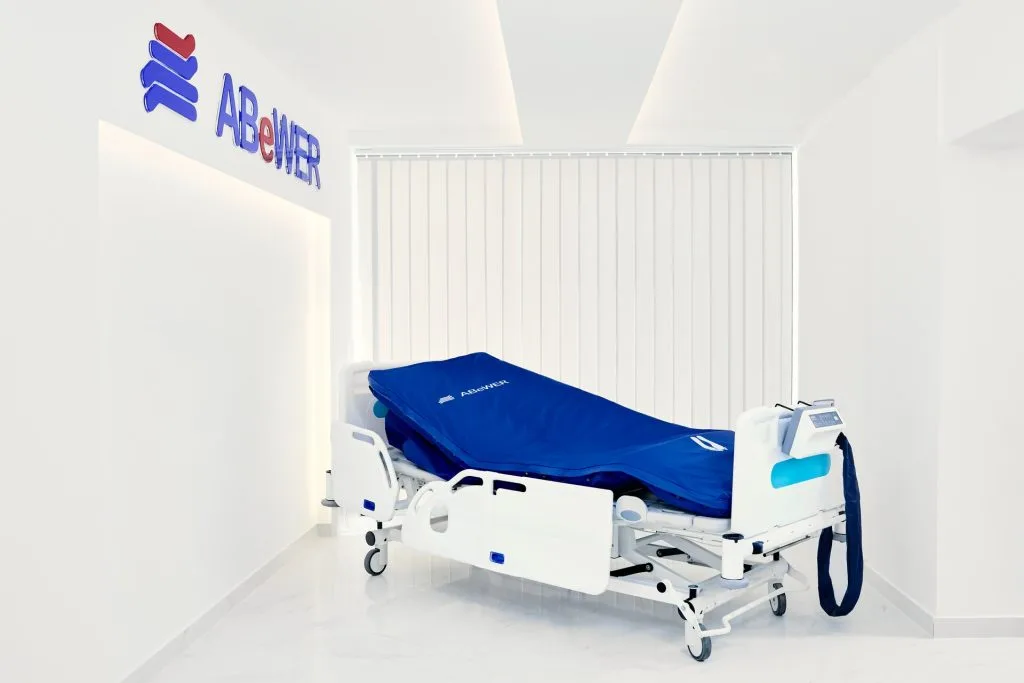
Multifunction devices aim to change that. Cyprus-based ABeWER has developed the multiTURN® 6, a CE-certified lateral rotation mattress for pressure ulcers that combines automatic 30-degree lateral turning with alternating pressure, continuous low pressure, low air loss, and head and leg elevation in one medical device. Several new systems are now challenging the old assumption that pressure injury prevention requires a stack of separate technologies.
Clinical Evidence and Practical Points
Comparative studies show better healing of Stage 3 and Stage 4 pressure injuries on multifunction lateral turning systems than on single-function alternating pressure mattresses alone. The 2025 International Guideline now recommends considering automated repositioning as part of a broader prevention strategy.
But on a hospital ward, practical details matter just as much as clinical data. Does the mattress fit standard bed frames? Can it run quietly enough for patients to sleep through the night? Can someone with a spinal cord injury operate it independently? These questions determine whether a product works in real life, not just in a study.
A Shift in Thinking
Prevention should come before treatment. That sounds obvious, but pressure injury care has historically been reactive: wait for damage, then treat it. Regular, automated prevention leads to fewer injuries, shorter hospital stays, and more time for the kind of care that actually requires a human being.
Lateral rotation technology won’t solve the repositioning problem on its own. But it fills a real gap between what clinical guidelines recommend and what actually happens at the bedside when the ward is understaffed and the night is long.
